Check Engine Light On? Read the Codes Before You Buy That Used Car
Quick answer: Before you buy any used car, plug a basic OBD2 scanner into the port under the dash on the driver's side and check two things: the trouble codes, and the readiness monitors. If several monitors say "not ready" or "incomplete," the codes were cleared recently and hidden problems may not have shown up yet — walk away or wait until the car completes its checks.

Recommended · Temu
1080P Video Doorbell Camera — Wireless, No Drilling
Your car sleeps in the apartment lot. This camera sticks on with no drilling, runs on a battery, and shows your front door — and who is near your car — right on your phone. 4.7 stars, 250K+ sold.
$9.98 on Temu
See the doorbell on TemuAffiliate link: if you buy, this site may earn a commission at no extra cost to you. Price checked September 2026; Temu prices change often.
Here is a trick that costs buyers thousands: a seller clears the codes, and the check engine light goes dark. The dash looks clean. The car drives fine around the block. You hand over your down payment — and three days later, on your way to work, the light is back on. So is the repair bill.
The light was never fixed, just erased.
The good news: the car itself remembers this happened. You do not need to be a mechanic to catch it. You need a basic OBD2 scanner — the cheap class, around $14 to $20 — and five minutes. One screen, the readiness screen, tells you if the memory was wiped recently.
Scan before the down payment moves — that is the one moment the seller needs you more than you need the car. After it, every problem the scanner would have found is your problem.
What is the cleared-code trick, and how do you catch it?
Every car sold in the United States from the 1996 model year on has OBD2 — On-Board Diagnostics, second generation, the car's built-in self-check system. When something fails its test, the computer stores a code and usually turns on the check engine light.
Anyone with a scanner can clear those codes in ten seconds. Clearing turns the light off — it does not fix a thing — and it resets the readiness monitors.
Readiness monitors, in plain words. These are self-tests the computer runs on its own parts — the catalytic converter, oxygen sensors, fuel vapor (EVAP) system, and others. Each test only runs under the right conditions, like a cold start and steady driving. Clearing resets every monitor to "not ready." As you drive over days, each test runs again and flips to "ready."
- Most monitors "ready," no codes: the car has been driven normally since any clearing. What you see is close to the truth.
- Several monitors "not ready," no codes, light off: the memory was cleared recently — for a repair, a dead battery, or to hide something — and a fault can still be hiding.
- A seller who will not let you scan: you have your answer. Walk.
A dead battery also resets the monitors, so "not ready" is not proof of lying — it is proof you cannot trust what you see yet. Do not buy until the car has had several days of normal driving and the monitors complete, then scan again. A freshly cleared car can also fail emissions inspection in areas that test: inspectors read the same monitors, and too many "not ready" means the car gets turned away.
Where is the OBD2 port, and how do you scan in five minutes?
The port is a standard 16-pin connector within reach of the driver's seat — on most cars, under the dashboard on the driver's side, near the steering column or above the pedals, sometimes behind a small cover.
Do the scan with the seller standing right there.
- Do the bulb check first. Turn the key to "on" without starting the engine (or press the start button without your foot on the brake). The check engine light must come on for a few seconds. If it never comes on, the bulb is dead or tampered with — a serious red flag, and emissions inspections fail cars for it.
- Plug in the scanner. Turn the key to "on." The scanner connects on its own.
- Read the codes. Write down every code — you can look them up on your phone right there.
- Check the readiness screen. Look for I/M Readiness or Monitors. More than one or two "not ready" on a car the seller claims has been driven daily is a warning.
- Check all three code types. Stored, pending, and permanent — the next section explains why.
Recommended · Temu
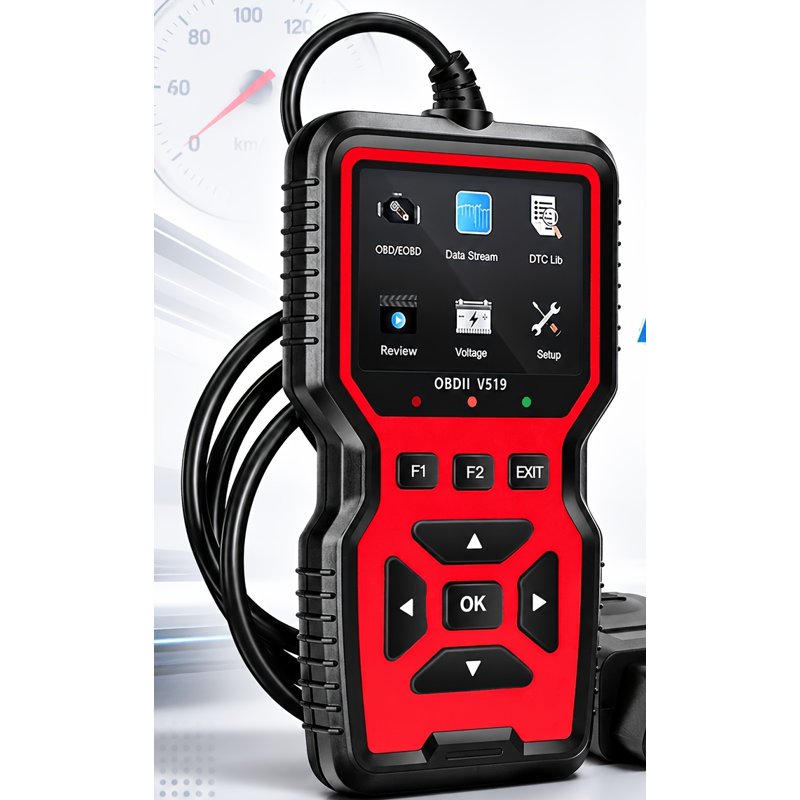
V519 OBD2 Scanner — Check Engine Code Reader
Before you sign for that used car, plug this in under the dash and read the codes yourself. It shows check-engine codes and live data — the stuff a seller hopes you never check. 4.6 stars, 28K+ sold on Temu.
$17.01 on Temu
See the scanner on TemuAffiliate link: if you buy, this site may earn a commission at no extra cost to you. Price checked September 2026; Temu prices change often.
What is the difference between stored, pending, and permanent codes?
Stored (confirmed) codes. The computer saw the fault, confirmed it, and turned the light on. If the light is on while you shop, this screen tells you why. Check the other two buckets too.
Pending codes. The computer saw a fault once, but has not confirmed it yet, so the light may still be off — an early warning of a problem that may turn the light on in your first week.
Permanent codes. These are the ones a seller cannot erase. A permanent code records an emissions-related fault and stays in memory even if someone clears codes or disconnects the battery. It only goes away when the car itself confirms the problem is truly fixed. If one shows up, something was wrong recently, no matter how clean the dash looks.
Rule of thumb: light off, no codes in any bucket, and monitors ready is a clean scan. Anything else needs paperwork, not promises.
Which codes mean walk away, and which are cheap fixes?
A code tells you which system raised its hand, not the exact broken part. But some codes live in expensive neighborhoods, and on a car you do not own yet, expensive is a reason to walk. For solid picks on a budget, see the best cars for bad credit buyers.
Walk-away codes on a car you have not bought yet:
- P0300, and the misfire family (P0300–P0304 and up). Random or multiple cylinder misfire — the engine is not firing right. It could be cheap spark plugs, or a dying engine. A flashing light means a severe misfire happening now, the kind that can destroy the catalytic converter.
- P0420 (and P0430 for the other bank). Catalyst system efficiency below threshold — the catalytic converter is not cleaning the exhaust like it should. Converters are one of the priciest emissions parts on the car, and this code fails emissions inspection.
- P0700 and the transmission range (P0700s). P0700 means the transmission's own computer found a fault — the most expensive trouble there is on an older car. Unless a shop you trust clears it, walk.
Often-cheap codes — still verify, but do not panic:
- P0455 and P0442. EVAP system leak, large (P0455) or small (P0442). The EVAP system keeps fuel vapors from escaping, and the most common cause is simple: a loose or worn gas cap. Replace the cap and the code may never return. Hoses and valves cost more, but this is usually the cheapest fix in the book.
Get any code priced by an independent shop before you commit, and learn the other tricks in common dealer traps.
Recommended · Temu
6x4 Ft Brown Outdoor Storage Shed with Lockable Double Doors
Just bought the car? Clear the garage so it actually fits. This weatherproof steel shed has lockable double doors — and no monthly storage-unit bill.
$137.21 on Temu
See the shed on TemuAffiliate link: if you buy, this site may earn a commission at no extra cost to you. Price checked September 2026; Temu prices change often.
When should you scan — before or after the down payment?
Before. Always before. Your down payment is the hardest money you ever saved — for most bad-credit buyers, it is the gate between walking and driving. Before it moves, a bad scan costs you nothing but a walk across the lot. After it, a bad scan is an argument, and your deposit is hard to get back.
So say it out loud: "Before any money moves, I am plugging in my scanner, and if the monitors are all not ready, we wait until it has been driven and I scan it again." A straight seller says fine. A seller who rushes you past that is telling you everything.
Once the car is yours, keep the scanner in the glove box, with the rest of what a new owner needs in our car emergency kit checklist.
Recommended · Temu
2-Pack 3-Head Solar Security Lights (3000LM, Motion Sensor)
Your car sits outside overnight — apartment lot, driveway, or street. This 2-pack of solar security lights (3000LM, motion sensor) keeps it lit and watched — no wiring, no electrician, no monthly cost.
$22.26 on Temu
See the solar lights on TemuAffiliate link: if you buy, this site may earn a commission at no extra cost to you. Price checked September 2026; Temu prices change often.
Recommended · Temu
Portable Tire Inflator — Cordless Air Pump (150 PSI)
A flat tire on the way to work can cost you the job that pays for the car. This cordless inflator rides in the trunk and fills a tire in minutes — no gas-station air pump, no tow truck. 4.8 stars, 35K+ sold.
$7.45 on Temu
See the inflator on TemuAffiliate link: if you buy, this site may earn a commission at no extra cost to you. Price checked September 2026; Temu prices change often.
Frequently asked questions
Can a seller really hide a check engine light by clearing the codes?
Yes. Clearing turns the light off until the computer runs its tests again and the fault returns, which can take a few days of driving. That is why you check readiness monitors and permanent codes, not just the light.
What does it mean if the readiness monitors say "not ready" or "incomplete"?
It means the computer has not finished its self-tests since its memory was last cleared — by a code clear, battery disconnect, or repair. It is not proof the seller cheated, but hidden faults may not have appeared yet. Wait until the monitors show "ready," then scan again.
Where do I plug in an OBD2 scanner on a used car?
Under the dashboard on the driver's side, near the steering column or above the pedals. Every car sold in the U.S. from the 1996 model year on has this standard 16-pin port.
What if the check engine light does not come on when I turn the key?
That is a red flag by itself. At key-on, the light must illuminate briefly — the bulb check — to prove the warning system works. If it never lights, the bulb may be dead or removed to hide a fault, and emissions inspections fail cars for this. Walk away.
Can a recently cleared car pass an emissions inspection?
Usually not right away, in areas that test emissions. Inspectors check the same things you can: the light must work at key-on, be off while running, codes must be clear, and most monitors must show "ready." A car cleared that morning typically gets turned away.
<!-- sources: EPA / 40 CFR Part 85 and EPA OBD guidance via emissions-testing and inspection references — OBD-II required on all cars and light trucks sold in the U.S. from the 1996 model year (diesel followed in 1997), standardized 16-pin Data Link Connector within reach of the driver's seat, typically under the dash on the driver's side; readiness monitors reset to "not ready" when codes are cleared or battery disconnected, and complete after drive cycles; Pennsylvania Title 67 Ch. 177 OBD I/M procedures (EPA snapshot) — key-on/engine-off "bulb check," MIL must illuminate briefly or the car fails; California BAR / OBD references via Innova and OBD guides — stored vs. pending vs. permanent DTC definitions, permanent codes cannot be erased by scan tool or battery disconnect and clear only after the car verifies the repair; standardized DTC definitions (SAE J2012 family): P0300 random/multiple cylinder misfire, P0420/P0430 catalyst efficiency below threshold, P0700 transmission control system malfunction, P0442 EVAP small leak, P0455 EVAP large leak (commonly gas cap). Scanner price framed as the site's cheap-scanner class (~$14-$20 basic models), not a market statistic. -->